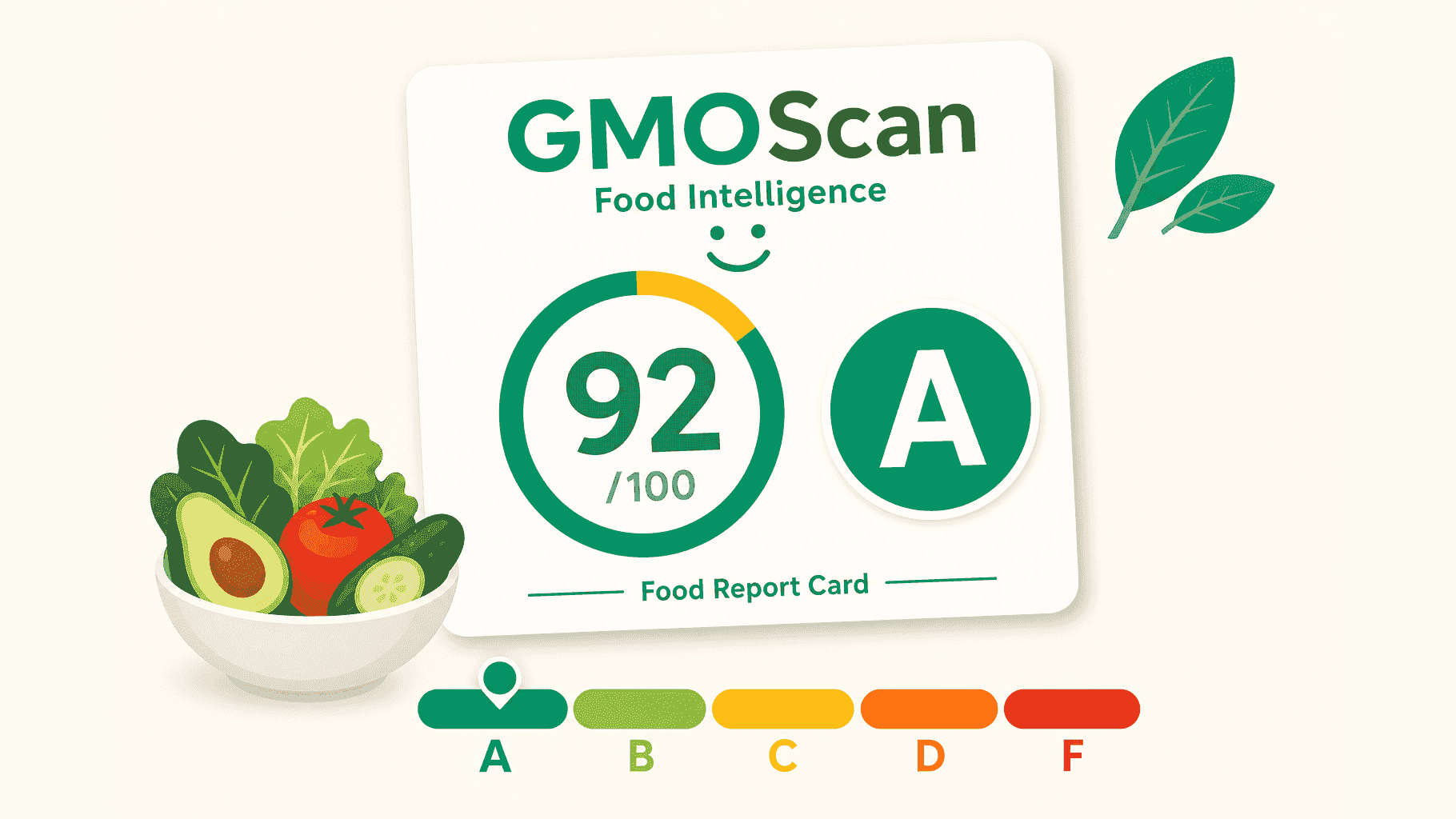
Every product you scan earns a Food Intelligence Score — a single number from 0 to 100 paired with a simple letter grade (A–F). Together they make any label easy to read and easy to compare.
Score and grade, side by side
The letter grade is just the 0–100 score translated into a familiar A–F scale, so you can judge a product in a second:
| Grade | Score | What it means |
|---|---|---|
| A | 90–100 | Exceptional whole-food quality |
| B | 75–89 | Strong nutritional profile |
| C | 60–74 | Acceptable, but processed |
| D | 40–59 | Ultra-processed with moderate concerns |
| F | 0–39 | Highly processed, poor nutrition, or too little data |
Grades A–B show green, C shows yellow, D shows orange, and F shows red — the same colors you'll see on the score card and ingredient list.
What the score looks at
The score comes straight from what's on the label — nothing is guessed. In plain terms, it looks at:
- How nourishing it is — the balance of things like protein, fiber, sugar, and sodium.
- How clean the ingredients are — shorter, simpler lists score better than ones full of additives.
- How processed it is — close-to-whole foods score higher than heavily processed ones.
- How much we know — if the label doesn't give enough detail to judge fairly, the score reflects that.
Organic and non-GMO signals on the label help, too.
How to read it
- Scan or search a product.
- Read the letter grade and score first for the quick verdict.
- Expand the report for the "why" — ingredient notes, nutrition, processing, and GMO/organic flags.
- Compare with a similar product to find an easy upgrade.
Tip: two products that look alike can grade very differently. Let the score and grade point you to the better choice, then read the details to learn why.
Remember: the Food Intelligence Score is educational, not medical advice. Always follow the physical label and your healthcare provider for medical decisions.