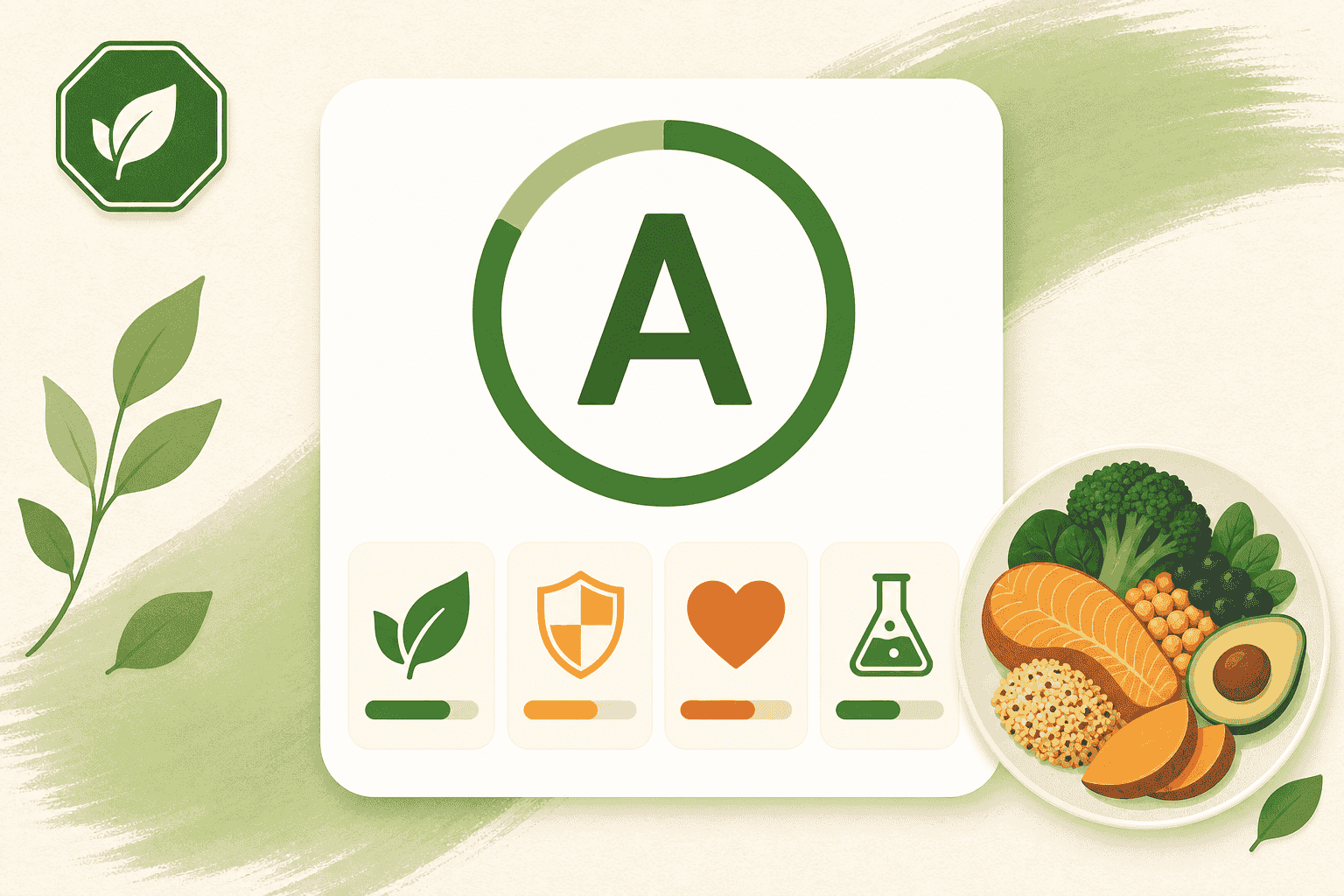
When you build a dish in Meals & Recipes, it earns a Meal Intelligence Score — a number from 0 to 100 with a familiar A–F letter grade.
It's the same rigor behind the Food Intelligence Score you see on packaged products, applied to real food that never had a barcode.
Score and grade, side by side
| Grade | Score | What it means |
|---|---|---|
| A | 90–100 | Exceptional whole-food quality |
| B | 75–89 | Strong nutritional profile |
| C | 60–74 | Acceptable, but processed |
| D | 40–59 | Heavily processed with moderate concerns |
| F | 0–39 | Highly processed, poor nutrition, or too little detail |
What the score looks at
Your meal is judged on four things, shown as tiles on the report:
- How nourishing it is — the balance of protein, fiber, sugar, sodium, and more across everything in the dish.
- How clean the ingredients are — simple, recognizable ingredients score better than long lists of additives.
- How processed it is — a dish built from whole foods scores higher than one built from heavily processed components.
- How much we could confirm — how much of your meal we matched to real food data. Vague entries lower this.
Ingredients you mark Organic or Non-GMO count in your favor, proportional to how much of the dish they make up.
Why some scores say "provisional"
A provisional badge means the score leaned on estimated portion sizes rather than amounts you supplied — normally because you used Quick mode.
It's still a genuine, useful read. To firm it up:
- Open the meal and tap Edit.
- Add real quantities to your main ingredients.
- Switch to Full mode and Regenerate score.
Confidence, not guesswork
The report tells you how much of your dish was matched to real nutrition data. When too little can be confirmed, the nutrition portion is shown as not measured rather than invented — the score reflects what we honestly know.
That's the point: the truth is in the ingredients, including the truth about how much we can verify.
Read the write-up, not just the grade
Under the score you'll find a plain-language overview, the dish's key benefits, and any watch-outs worth knowing. That's usually where you spot the one ingredient holding a good meal back.
Remember: the Meal Intelligence Score is educational, not medical advice. Always follow the physical label and your healthcare provider for medical decisions.
Next: Score a restaurant meal